
Behavioral Intelligence for Institutional Investors

TransparencyAI: Behavioral Intelligence for Investment Research and AI Workflows

TransparencyAI (TAI) applies BIA’s proprietary Tactical Behavior Assessment® methodology to earnings calls and other public management communications to identify where management may be less transparent, less forthcoming, or less consistent around material issues. Drawing on more than 20 years of proprietary behavioral data, TAI provides investors with a differentiated behavioral lens to pressure-test the investment thesis and focus diligence on the issues and management responses that warrant closer attention.

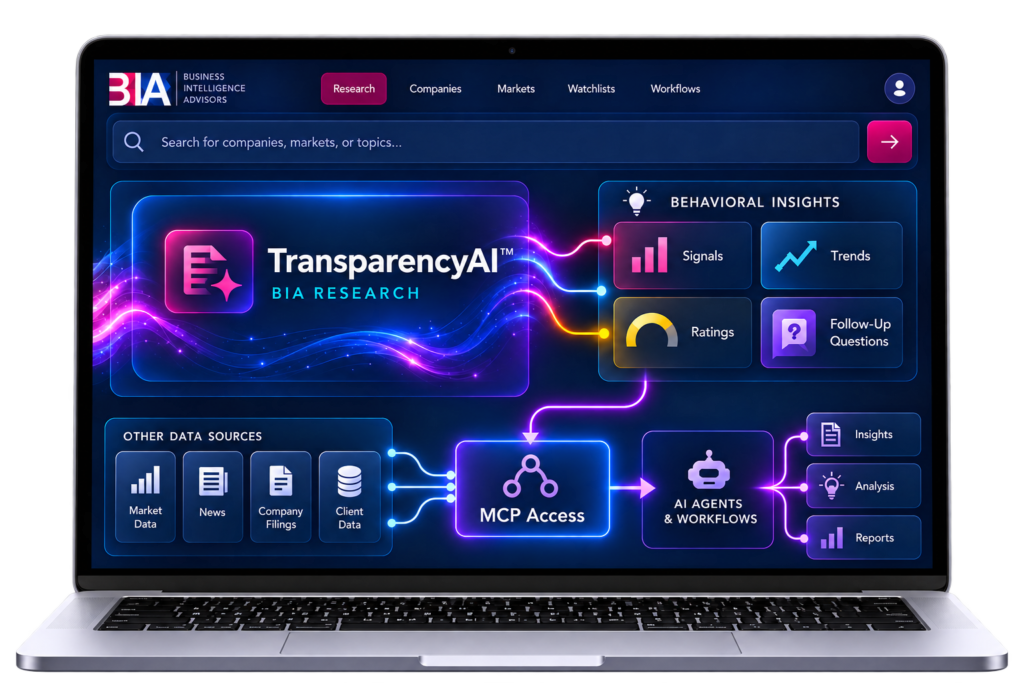
Access TAI through BIA’s research portal or integrate its behavioral intelligence directly into your firm’s existing AI, research tools and workflows through BIA’s MCP server.

Apply TAI To Investment Research
Bring TAI Into Your Research Environment
TransparencyAI - BIAdvisors

A Different Kind of Investment Input

Financial results tell you what happened. Transcripts and summaries tell you what management said. TransparencyAI evaluates what management may be holding back around material issues.

TransparencyAI

Behavioral signals showing where management is holding back around material issues

Financial Data

What happened

Transcripts & Summaries

What was said

Sentiment Analysis

Tone, positive/negative languag

Use TransparencyAI In Your Investment Process

Apply TAI to Investment Research

Use TAI’s behavioral analysis and source-linked findings to:

Bring TAI Into Your Existing Research Environment

Bring TAI’s behavioral intelligence into existing research and AI workflows via BIA’s MCP server allowing you or your AI agent to:

Behavioral Intelligence Goes Beyond Sentiment and Summaries

TransparencyAI is designed to evaluate the behavioral signals in how management communicates around material issues — providing a differentiated lens on conviction, concern, candor, consistency, and change over time. In contrast, sentiment analysis can identify tone and positive or negative language, while general-purpose LLMs can summarize, organize, and interpret what management said. 

Capability / Output Sentiment Analysis General-Purpose LLMs TransparencyAI (TAI)
Detects positive/negative tone BIA-Blue-Half-Circle-lighter –
Classifies language as positive / negative / neutral BIA-Blue-Half-Circle-lighter –
Summarizes management communication – BIA-Blue-Half-Circle-lighter
Identifies key topics and themes BIA-Blue-Half-Circle-lighter2
Answers natural-language research questions –
Identifies behavioral signals (conviction, confidence, concern, avoidance etc.) in management communication – –
Evaluates changes in language over time – BIA-Blue-Half-Circle-lighter
Identifies potential upside & downside signals BIA-Blue-Half-Circle-lighter BIA-Blue-Half-Circle-lighter
Analyzes individual management exchanges BIA-Blue-Half-Circle-lighter –
Provides an overall-report / call rating –
Links findings to supporting source exchanges – BIA-Blue-Half-Circle-lighter
Compares management behavior across companies – BIA-Blue-Half-Circle-lighter
Helps test and monitor an investment thesis BIA-Blue-Half-Circle-lighter BIA-Blue-Half-Circle-lighter
Helps identify areas requiring additional diligence BIA-Blue-Half-Circle-lighter BIA-Blue-Half-Circle-lighter
Provides psychologically effective management follow-up questions – –

Note: General-purpose LLM capabilities depend on the model, prompt, available source material, and workflow. TransparencyAI is purpose-built to apply BIA’s proprietary behavioral methodology to management communications.

What TAI Delivers

Each TAI report provides a structured assessment of how management communicated and responded around the material issues addressed during a quarterly earnings call or other public management communication.

TAI evaluates individual management exchanges and synthesizes those findings into standardized call-level behavioral ratings, with the underlying evidence linked to each assessment.

How TransparencyAI Works

1

Management Communications

Earnings calls and other public management communications

2

Proprietary Tactical Behavior Assessment® Analysis

BIA’s methodology evaluates behavioral signals around material issues, drawing on a proprietary dataset developed over more than 20 years

3

Standardized Behavioral Intelligence

TAI applies the methodology consistently across management exchanges and synthesizes the analysis into comparable behavioral assessments

1234

Research and AI Workflows

Access TAI through BIA’s research portal or bring its behavioral intelligence into client research environments through BIA’s MCP server

A proprietary behavioral lens that helps investors assess management credibility, pressure-test the thesis, identify meaningful change, and focus diligence.

Proven Methodology. Consistent Application. Greater Scale.

Independent validation, human-to-AI agreement, real-world outcome testing, and systematic scale.

Independent research has supported the investment relevance of BIA’s behavioral methodology.

A comprehensive back-test conducted by a Harvard Business School professor examined more than 3,000 BIA earnings-call analyses spanning eight years and found that BIA’s behavioral ratings were associated with distinct subsequent stock-performance outcomes.

3,000 ANALYSES

—

8 YEARS BACKTEST

TransparencyAI replicates BIA’s expert research.

Validation against BIA’s human-written reports has shown greater than 95% agreement at the individual-exchange level.

95% AGREEMENT

–

AT THE INDIVIDUAL EXCHANGE LEVEL

TAI findings have also been evaluated against subsequent information and events.

In a study of Q4 2025 TAI analysis, among conclusions that could be definitively validated or disproven, confirmed conclusions outnumbered incorrect conclusions by approximately 3 to 1

3:1 CONFIRMED vs INCORRECT

TAI applies the behavioral framework consistently at scale.

It enables BIA’s methodology to be applied systematically across a much broader universe of management communications while preserving the analytical framework underlying BIA’s historical research.

Example Workflows

Test the Investment Thesis

“Review the latest call for behavioral signals that support or challenge our thesis that margin pressure is temporary. Identify the issues and management responses that warrant further diligence.”

Investor benefit:

Surfaces behavioral evidence that supports or challenges the thesis and links it to relevant management exchanges.

Identify Material Shifts

“Over the past two quarters, which companies changed by at least two points in their TAI rating? Identify the themes driving each change and whether the movement strengthens or weakens the investment case.”

Investor benefit:

Investor benefit: Screens a portfolio or coverage universe for meaningful improvement or deterioration and identifies the themes driving the change.

Use TAI In a Proprietary Model

“Return quarterly TAI ratings, theme-level changes, and supporting classifications for all companies in my portfolio in a structured format for use alongside our model.”

Investor benefit:

Makes behavioral intelligence available for internal screening, monitoring, analytics, and proprietary models.

Prepare for a Management Meeting

“Review the latest call and recent TAI history for this company. Identify the topics where management showed behavioral signs of concern, changing conviction, or reduced candor, and suggest follow-up questions to probe those issues in our meeting.”

Investor benefit:

Focuses meeting preparation on the issues that warrant deeper probing and turns behavioral signals into sharper, targeted follow-up questions.

Use TAI to Monitor Current Positions

“Which companies in our portfolio show new behavioral warning signs or meaningful deterioration since the prior quarter?”

Investor benefit:

Surfaces material changes across the portfolio and helps focus attention on positions that may warrant deeper review.

What Makes TransparencyAI Different

Proprietary Behavioral Intelligence for Institutional Investors

TAI is grounded in BIA’s proprietary Tactical Behavior Assessment® methodology, developed from techniques with origins in the U.S. intelligence community and refined through more than 20 years of work with institutional investors. Its proprietary behavioral dataset is built from hundreds of thousands of management Q&A exchanges.

20+ years of Proprietary Historical Data

A proprietary training dataset built from BIA expert analysis of hundreds of thousands of tagged management Q&A exchanges.

Purpose-Built Behavioral Methodology

BIA’s Tactical Behavior Assessment® methodology assesses how management communicates and responds around material issues—not simply the tone or content of the words.

Source-linked, Comparable Intelligence

Standardized behavioral ratings and findings are linked to the underlying source exchanges, enabling consistent comparison across companies and over time periods.

Frequently Asked Questions

TransparencyAI (TAI) is BIA’s proprietary behavioral intelligence solution for institutional investors. It analyzes management communications using BIA’s proprietary Tactical Behavior Assessment® methodology and delivers behavioral ratings, analysis and trends that can be used by investment professionals or accessed programmatically as structured intelligence through BIA’s MCP server or as research through BIA’s online portal.

Behavioral intelligence evaluates how management communicates and responds when addressing material investment issues. It looks for signals such as conviction, concern, candor, avoidance, sensitivity, and consistency that may provide a different perspective from financial data, transcripts, estimates, or conventional language analysis alone.

Sentiment analysis primarily classifies the tone of language as positive, negative, or neutral. TransparencyAI applies a proprietary behavioral methodology to evaluate how management communicates and responds to specific issues, including signals of conviction, concern, candor, avoidance, sensitivity, and consistency over time.

General-purpose AI tools are useful for summarizing and interpreting what management said. TransparencyAI adds a specialized  behavioral layer: it evaluates how management communicated around material issues, assigns behavioral ratings, identifies changes and patterns, and links findings back to the relevant source exchanges.

Investment professionals can use TAI to test and monitor an investment thesis, identify emerging risks or possible inflection points, track changes in management conviction and concern, compare management behavior across companies, prioritize diligence, and prepare more targeted questions for management discussions and meetings.

Yes. TAI can track behavioral ratings and themes across quarters, speakers, and public management communications. This allows investors to identify meaningful improvement, deterioration, inconsistency, or shifts in management behavior around issues that matter to the investment thesis.

TransparencyAI is available in two ways. Investment professionals can access TAI behavioral research reports through BIA’s online portal. Firms can also access TAI through BIA’s MCP server, bringing behavioral analysis into supported research environments, AI tools, and internal workflows.

Yes. Structured, machine-readable TAI output can be used in internal analytics, screening tools, scoring frameworks, risk systems, and proprietary investment models. Firms can also combine TAI behavioral intelligence with financial data, estimates, market data, alternative data, internal research, and other proprietary inputs.

No. TAI is not a standalone buy/sell signal. It provides differentiated behavioral intelligence that investors can use alongside fundamental research, financial data, market information, and the other inputs unique to their investment process.

TAI ratings reflect the intensity of the behavioral signals or lack of transparency observed in management’s responses. A higher-concern rating does not necessarily imply a negative outcome for the company or its stock. TAI provides the behavioral analysis and supporting evidence so investors can assess the investment significance in the context of their own research.

Accordion Content

MCP (Model Context Protocol) is a standard that allows AI tools and applications to connect to external data sources. BIA’s MCP server allows authorized AI and research applications to access TAI behavioral intelligence directly within a firm’s existing workflows.

TransparencyAI applies BIA’s proprietary Tactical Behavior Assessment® methodology to earnings calls and other public management communications. It evaluates behavioral signals in how management responds around material issues, analyzes individual management exchanges, and links findings to the underlying source evidence.

Transcripts and summaries capture what management said. TransparencyAI evaluates how management communicated and responded around material issues, providing a behavioral perspective on signals such as conviction, concern, candor, avoidance, sensitivity, and consistency.

Yes. Investors can use TAI to screen a portfolio, watchlist, or coverage universe for changes in behavioral ratings, emerging areas of concern, and other findings that may warrant deeper diligence.

Yes. TAI findings are linked to the relevant questions and management responses from the source transcript, allowing investors to review the behavioral evidence in context.

TAI reports are typically available within 1–2 hours of transcript release, allowing investors to incorporate behavioral analysis into post-earnings research and diligence.

Bring Behavioral Intelligence Into Your Investment Process

Discuss research access, MCP integration, or a pilot implementation.